产品介绍
气盾橡胶坝简介
气盾橡胶坝(RiverMate®PSRD)是水泥坝、钢坝(闸门)及传统橡胶坝的更新换代产品,新型水工建筑物。该坝20世纪90年代由美国研制,2008年,水利部立项“引进、吸收、消化、提高、再创新”,并将气盾坝列入国家推广应用计划。项目由沈阳化大高分子材料研发中心、江河机电和铁岭尔凡共同完成,并于2012年在四川瞳南成功完成国内首例PSRD工程-瞳南加高发电工程。气盾坝继承了传统活动坝型之精华,克服了传统活动坝型的瓶颈问题,具有结构简单,建设、安装、使用及维护简单快捷的特点;防洪渡汛能力突出,运行安全可靠;过水高度和运行状态持续可控;具有更强的清污、排淤能力;挡水和过水能力更高;充排时间短,运行管理简单;使用寿命超长,综合效益高;抗震能力强,对基础的适应性高;景观效果好及具备生态及环境友好等特点。
特点:
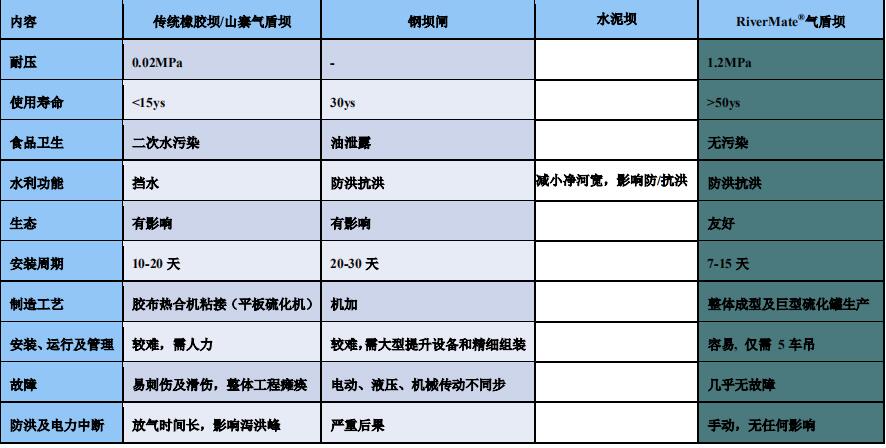
1、耐老化,使用寿命超过50年;
2、耐高压大于1.2MPa;
3、耐刺伤及划伤;
4、“绿色”:食品卫生技术指标好于国标要求4个数量级,无漏油及机械杂质问题,不会造成水和周围环境的污染;
5、手动、自动及遥控水位,可连续调节,水流缓慢加速,不容易产生气穴、冲刷及旋涡。尤在洪水引起断电时,仍可靠地通过排气控制水位安全泄洪。泄洪后。即使闸门上沉积污泥等杂物,仍可正常运行;耗电低;
6、结构简单,造价低;模块结构简化了安装、运行及维护过程;
7、弧形门体能有效的使水流、冰块、瓦砾和树枝等杂物容易流过,并保护橡胶坝体,门体加筋板兼导流功能,可平顺水流,减少冲刷;
8、冬季可自行破冰;
9、钢板是由与钢板一样长的充气袋体支撑着,只需要简单的地基。可在既有的基础上施工,可用于大坝加高;
10、由一片片钢板及坝袋连接而成,长度不受限;且无中间的墩座,维持了河道净宽;节省了启闭设备和相应的土建结构;
11、即使在没有电的情况下可以准确自动控制水位(特别适合水力发电),安全性高;
12、抗震能力更强。盾板与基础之间是软连接,不会因基础变形造成系统失灵和丧失正常运行能力;
13、无人职守,管理运营成本低;
14、具备生态调节、美观、防洪抗洪及发电功能。
应用
1、蓄水:气盾坝可以在枯水/少水季节增加河道的蓄水量,形成一段一段的“水库”,具备很好的生态效益;很好的协调溢洪道的调水能力与水库蓄水位之间的关系,增加已建水库的蓄水量;减少增加蓄水量而带来的政策方面和资金方面的困难(如淹没问题);当现有溢洪道泄流能力不足时,采用这种坝/闸门的形式,保持堰顶高程而不影响水库的蓄水位和发电效益。
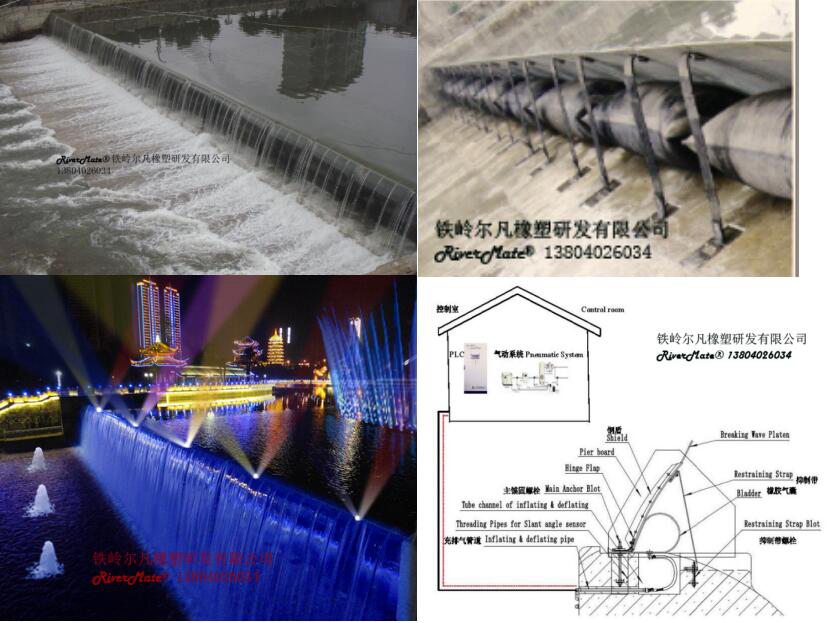
2、景观:坝顶溢流会形成瀑布,可在PSRD上安装景观灯及音响,产生很好的夜景及悦人的环境。
3、灌溉:可以准确控制灌溉渠道的水位和分流流量;当渠道流量变化时,可以自动控制分水建筑物前的水位,保证分水的均匀性。
4、分水、泻洪:可以应用到河流的分洪工作中,使水流量自动调节;在洪水期自动控制上游水位,使其保持低水位,并借助洪水带走上游沉积的泥砂;或直接全班倒伏,保证原河道的泻洪能力。
5、发电:形成高水位,增加水电站的发电能力;一般泄水闸板顶部过水深度仅为0.25-0.5m,PSRD可以创造较高水头并可以准确控制上游水位,汛期安全泄放洪水,汛期过后PSRD升起挡水;此外,冬季上游可以形成稳定的冰盖,防止冰凌堵塞电站引水口。
6、鱼道和环境保护:可以采用一系列的气盾坝形成梯级工鱼道,控制流量和流速,使鱼类平顺过坝;控制上游水位可以防止库区的水鸟窝突然被淹没,稳定的水位可以改善库区的安全及自然景观。
7、道路和车库的防护:PSRD可以设置在车库、地铁入口处,防止暴雨洪水进入;也可以布置于防洪堤的缺口处,洪水来时立刻关闭。
8、通航:PSRD是一种很理想的船闸上下游闸门形式,它可以准确控制上下游水位;塌坝时钢板覆盖在橡胶气囊上,保证船舶顺利通过;减少复杂的闸门启闭系统,操作灵活简便;降低船闸的建造和维护费用。
结构简介
气盾坝组成:坝体(橡胶气囊+钢盾)、锚固件、气动系统、自控系统及管道。
1、坝体
橡胶气囊由多层骨架纤维材料及橡胶材料构成。纤维材料可以是聚酯、尼龙、芳纶或钢丝;橡胶材料分为三层:外胶是耐候性优异的三元乙丙橡胶(EPDM),中胶是粘合性好的氯丁和天然并用橡胶(CR+NR),内胶是气密性优异的改性丁基橡胶。钢盾(也包括墩板)根据应用要求可采用:碳钢(须做锌+涂料的防腐处理)、304不锈钢或316L不锈钢制造。气囊耐压设计应是使用压力的8倍以上(安全系数)。气囊使用寿命应超过50年。
2、锚固件
包括:预埋螺栓及定位金属结构件、紧固螺栓及定位金属结构件。材料可选用碳钢(须做锌+涂料的防腐处理)、304不锈钢或316L不锈钢。其尺寸规格及形状应满足工程及设计要求。
3、气动系统
应采用性能好的螺杆式空压机,规格应满足工程及设计要求最好是一用一备。
4、自控系统及管道
自控系统应包括:PLC、防雷设备和SKADA或及雷达水文监测。管道材质、尺寸规格及形状应满足工程及设计要求。
5、气盾坝制造安装及验收规范T/CHES11-2017及气动盾形闸门系统设计规范T/CHES24-2019制订单位,中国水利学会团体标准。
Introduction to Pneumatic Shield Rubber Dam
RiverMate® PSRD (Pneumatic Shield Rubber Dam) is a new type of hydraulic structure serving as an upgraded alternative to concrete dams, steel gates and conventional rubber dams. Originally developed in the United States in the 1990s, the technology was designated for a national water conservancy research project in 2008 by the Ministry of Water Resources of China, with the mission of introduction, absorption, digestion, technical upgrading and re-innovation. PSRD was then included in the national promotion and application program.
The R&D project was jointly completed by Shenyang Huada Polymer Material R&D Center, Jianghe Electromechanical Equipment Co., Ltd. and Tieling Erfan Rubber & Plastic R&D Co., Ltd. In 2012, China’s first domestic PSRD project – the Tongnan Heightening & Power Generation Project in Sichuan Province – was successfully put into operation.
Core Characteristics
Excellent anti-aging performance with a service life exceeding 50 years
High pressure resistance over 1.2 MPa
Resistant to punctures, cuts and scratches
Eco-friendly and hygienic: its food-grade sanitary indicators surpass national standards by four orders of magnitude. No oil leakage or mechanical impurities occur, eliminating water and ambient pollution risks
Manual, automatic and remote water level control with stepless adjustment. Water flow accelerates gently to avoid cavitation, erosion and vortex formation. In case of power failure during floods, water levels can be reliably regulated via deflation for safe flood release. The dam operates normally even when sludge and debris accumulate on the shield plates after flood discharge; low power consumption
Simple structure and low construction cost. Modular design streamlines installation, operation and maintenance
Curved shield plates smoothly guide water flow, ice blocks, gravel, branches and other floating debris past the dam while protecting the rubber bladder. Reinforcing ribs integrated on shield plates double as flow guides to stabilize current and reduce scouring
Self-deicing capability in winter conditions
Steel shield plates are fully supported by inflatable bladders running the full length of plates, requiring only simple foundation works. Retrofit installation on existing foundations is feasible, making it ideal for dam heightening reconstruction
Assembled from segmented steel plates and rubber bladders with unlimited total length. Intermediate support piers are eliminated to preserve full river channel clear width, saving costs for gate hoists and auxiliary civil structures
Precise automatic water level control achievable without electricity, highly suitable for hydropower stations with superior safety performance
Enhanced seismic resistance. Flexible connections between shield plates and foundations prevent system malfunction or failure caused by foundation deformation
Unattended operation with low management and running costs
Multi-functional integration: ecological regulation, landscape beautification, flood control and hydropower generation
Application Scenarios
1. Water Storage
During dry seasons, PSRD creates segmented impoundments along river channels with prominent ecological benefits. It optimizes coordination between spillway regulation capacity and reservoir pool levels to boost storage volume of existing reservoirs, mitigating policy and financial obstacles such as inundation risks associated with capacity expansion. When spillway discharge capacity is insufficient, PSRD gates maintain fixed weir elevations without compromising reservoir water levels and power generation efficiency.
2. Landscape Engineering
Overtopping flow over the dam crest forms waterfalls. Landscape lighting and audio systems can be installed on PSRD to create stunning night views and pleasant waterfront environments.
3. Agricultural Irrigation
Accurately regulates water levels and diversion flow rates in irrigation canals. Automatically stabilizes water levels upstream of diversion structures amid fluctuating channel inflow to ensure uniform water distribution.
4. Flood Diversion & Flood Release
Deployable for river flood diversion with automatic flow regulation. During flood peaks, it lowers upstream water levels to trap and flush deposited sediment downstream, or fully collapses to restore the original river’s full flood discharge capacity.
5. Hydropower Generation
Elevates upstream water levels to boost power output. Conventional sluice gates only allow 0.25–0.5 m overflow depth, while PSRD builds higher water heads with precise pool level control. It safely discharges floodwaters during rainy seasons and reinflates to retain water post-flood. In winter, stable ice sheets form upstream to prevent ice jams blocking hydropower intake tunnels.
6. Fish Passage & Environmental Protection
Series-connected PSRD structures construct stepped fish passages with controllable flow discharge and velocity for unobstructed fish migration. Stabilized upstream water levels prevent sudden inundation of aquatic bird habitats, improving reservoir safety and natural scenery.
7. Flood Barrier Protection for Infrastructure
Installed at underground parking garages and subway entrances to block flash flood inflow; deployed at breached flood dikes for instant closure upon flood arrival.
8. Navigation Lock Gates
An optimal gate solution for upstream and downstream lock chambers with precise bi-directional water level control. When fully deflated, steel plates cover rubber bladders to enable unimpeded vessel transit. It simplifies complex hoisting systems for flexible, easy operation and cuts lock construction and maintenance expenses.
Structural Composition
The pneumatic shield rubber dam consists of dam body (rubber inflatable bladders + steel shield plates), anchor fittings, pneumatic system, automatic control system and piping works.
1. Dam Body
Rubber inflatable bladders: Constructed with multi-layer reinforcing fiber frameworks and composite rubber layers. Reinforcement fibers include polyester, nylon, aramid or steel wire. The rubber structure features three functional layers:
Outer layer: EPDM (Ethylene Propylene Diene Monomer) rubber with superior weather resistance
Middle bonding layer: Blend of Chloroprene Rubber (CR) and Natural Rubber (NR) with strong adhesion
Inner airtight layer: Modified butyl rubber with excellent gas impermeability
Steel shield plates (including pier boards): Fabricated from carbon steel (hot-dip galvanized plus coating anti-corrosion treatment), SUS304 stainless steel or SUS316L stainless steel per project requirements.
Safety factor for bladder pressure design exceeds 8 times the working pressure; guaranteed bladder service life over 50 years.
2. Anchor Fittings
Comprise embedded anchor bolts, positioning metal components, fastening bolts and matched metal frames. Material options: carbon steel (zinc plating + coating corrosion protection), SUS304 or SUS316L stainless steel. Dimensions and geometry comply with engineering design specifications.
3. Pneumatic System
High-performance screw air compressors are adopted, typically configured as one operational unit plus one standby unit with capacity matching design demands.
4. Automatic Control System & Piping
The control system integrates PLC units, lightning protection devices, SCADA platforms and radar hydrological monitoring equipment. Pipe materials, sizes and shapes conform to project design standards.
5.Formulating Organization of Industry Standards
Two group standards issued by the Chinese Hydraulic Engineering Society are applicable:
Specification for Manufacture, Installation and Acceptance of Pneumatic Shield Rubber Dam (T/CHES 11-2017)
Design Code for Pneumatic Shield Gate System (T/CHES 24-2019)
图片
http://www.rdpmcn.com/cn/index.asp
同类技术产品比较